The Complete Guide to Meta 24-Hour Messaging Window Rules
Understanding Meta’s 24-Hour Messaging Standard
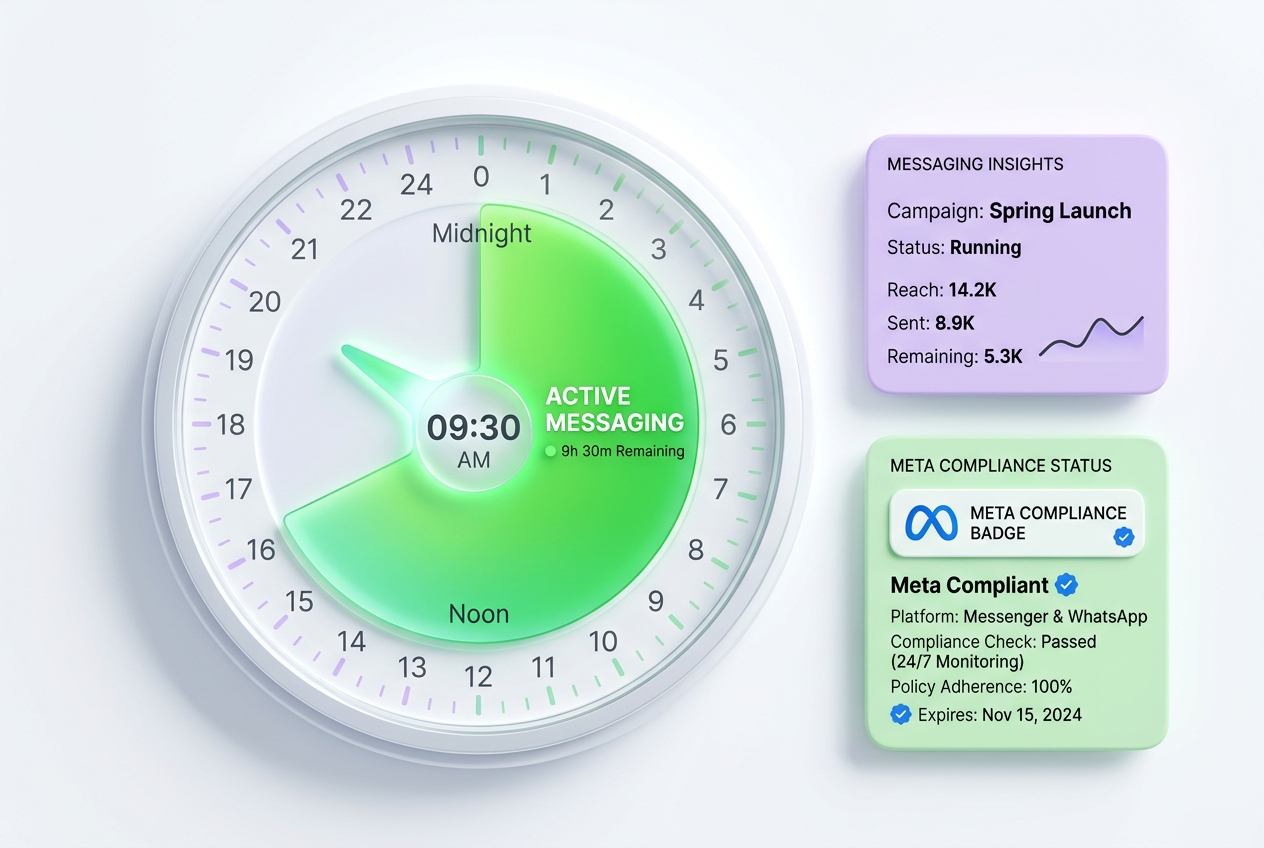
To preserve user trust and eradicate outbound spam across its messaging ecosystem, Meta strictly enforces the “Standard Messaging Window” policy. Under this protocol, whenever a user initiates an inbound action—such as sending a direct message, replying to a Story, or commenting on a post—a 24-hour timer opens during which businesses may deliver automated responses, product links, and rich media.
Once this 24-hour timeframe closes, businesses cannot push unsolicited promotional communications unless the customer voluntarily re-initiates conversation. Respecting this rule protects your profile’s reputation and guarantees continuous access to official messaging channels.
Comparison: Inside vs. Outside the 24-Hour Window
| Interaction State | Within 24-Hour Window | Post 24-Hour Expiration |
|---|---|---|
| Delivering Checkout Links | Fully allowed via Button Templates | Restricted until customer re-engages |
| Voice & Video Attachments | Supported with high deliverability | Blocked by official API endpoints |
| Interactive Quick Replies | Active and clickable in user inbox | Disabled |
Maximizing Conversion Within the 24-Hour Window
- Instantaneous Initial Dispatch: Trigger your product link or catalog within seconds of a comment or Story reply when customer intent is peaked.
- Reset the Clock with Quick Replies: Every time a customer taps an interactive quick reply button, the 24-hour window resets to zero, giving you another full day of compliant engagement.
- Showcase Product Carousels: Display comprehensive catalog options upfront so buyers have all necessary information within the first interaction.
Frequently Asked Questions
How can a brand restart an expired conversation?
Publish new organic posts, Reels, or Stories prompting followers to comment a keyword. When the user responds, a fresh 24-hour window opens instantly.
Does Odirect prevent policy violations automatically?
Yes. Our platform operates strictly within Meta’s compliant window framework, safeguarding your account from spam flags and penalties.
Practical implementation roadmap
To put “The Complete Guide to Meta 24-Hour Messaging Window Rules” into practice, define the problem in the customer’s language and separate verified information from details requiring human review. This boundary prevents unsupported promises and clarifies which answers can be reused. Match the entry point to real customer behavior; do not force unrelated needs into one journey.
1. Record a baseline
For several days, record sample questions, required answers, and cases that need an operator. Keep personal information out of shared templates. Group questions into a few needs and note the approved reply, review owner, and last-checked date. This makes later comparison more reliable than relying on impressions.
2. Design a clear path
Write a concise opening reply for each need that directly answers the question. Label choices precisely and remove redundant options. Make the next step explicit: view details, choose a product, or contact support. A link should lead to a relevant destination and work on mobile. Read the copy from the perspective of a first-time visitor.
3. Test before enabling
Use a test account to check the main phrase, common variations, similar but unrelated input, repeated messages, and every button. Follow the journey end to end to find duplicates or dead ends. Test comment and Story-reply entry paths separately where relevant, and record the results.
Measure quality and decide what to improve
Connect measures to the goal: did customers find the answer, repeat the question, use the next link or option, or need human help? Compare equivalent periods and note simultaneous changes such as campaigns or holidays. If clicks are low, review the destination and clarity of the action; if questions repeat, the reply may be incomplete. Do not generalize from a small sample.
Pre-launch quality checklist
| Area | Control question | Correction |
|---|---|---|
| Accuracy | Is the information approved? | Review and set next check date |
| Clarity | Is the next step obvious? | Simplify copy or button |
| Trigger fit | Does input match this reply? | Narrow and test examples |
| Exceptions | Can customers reach a person? | Add a clear handoff |
Preventable mistakes
- Do not promise prices, stock, or delivery without a reliable source.
- Do not send one long reply for several different needs.
- Do not publish vague buttons or unchecked links.
- Test a first-time visitor’s experience, not only the account owner’s.
- Do not measure success by message count alone; review answer quality and follow-up.
Illustrative example and limits
Imagine a business receives a recurring question on “The Complete Guide to Meta 24-Hour Messaging Window Rules”. The team gathers approved information, divides the reply into short parts, and creates clear options for distinct requests. It then tests the flow and revises unclear or incomplete steps. This illustrates a process, not a measured result or guarantee of sales growth; outcomes depend on the product, information quality, and customer behavior.
Review and maintain the content
Turn feedback into observations: which phrase was unclear, where did customers leave, what did they ask again, or which link did they not open? Look for causes in copy, journey design, or outdated information. Keep the prior version and change date so it can be restored if the experience worsens. Approve updates to prices, delivery, products, or account policies with the responsible owner. Assign each flow a review owner and next review date.
Related reading
For the next step, see these guides: Instagram DM Daily Limits: The Complete Safety Guide How to Fix Action Blocked on Instagram Direct Without Pausing Sales Why Automated DMs Land in Hidden Requests & How to Fix It How to Safely Share Website Links in Instagram DM Without Getting Flagged